Many delays in asset-heavy operations do not start on the shop floor. They start at a desk.
Take a planner building next week's schedule. Before a single job goes on it, they have to check which equipment is due for work, whether the spare parts are actually in stock, which crews and contractors are free, what permits each job needs and how long similar jobs took last time.
None of that information sits in one place. The planner pulls a report from the ERP, checks stock in another system, scrolls through old work orders, searches email for a contractor's dates and calls the senior technician who knows which jobs always overrun. By the time the schedule goes out, most of the effort went into finding information, not planning. Next week the same work starts again.
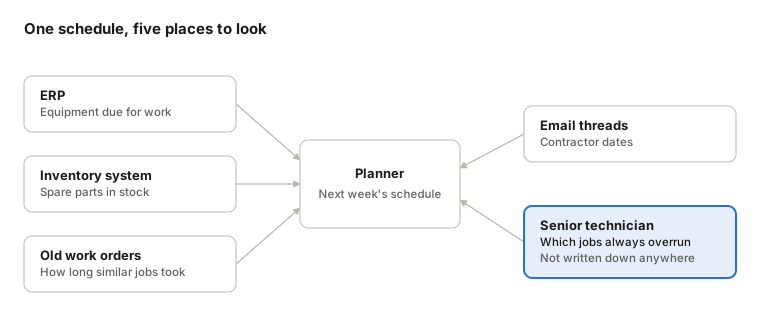
Four of the five sources are systems. The fifth, and often the most useful, is a person.
We see this on our own customer calls. When someone shares their screen to show us how they work, a surprising amount of the call goes to finding what to show. They click through folders and switch between systems, looking for the right file, while we wait.
By the time it is on screen, they have shown us the problem better than we could describe it. So that is where we start the conversation: we point back at the search they just did and ask how often it happens in a normal week.
This is desk work, and it quietly eats the time of some of the most experienced people in asset-heavy industries.
The answer exists, just not in one place
Most operations already have the information a decision needs. It is spread across the ERP, maintenance and inventory systems, engineering drawings, spreadsheets, email threads and shift logs.
This is not unique to heavy industry. Coveo's 2022 workplace survey of 4,000 employees in the US and UK found people spend 3.6 hours a day searching for information, and more than half search four or more sources just to get through a normal day.
The hardest part is not in any system at all. It is the know-how a few experienced people carry: which vendor to avoid, which spec actually works, the rule everyone follows that was never written into a policy. When a request needs that knowledge, the work waits until that person is free. When they retire, much of it leaves with them.
What desk work costs
The cost rarely shows up as a line item. It shows up in everything that waits.
- Slow decisions. Schedules, orders and bids queue behind the time it takes to assemble context. A part that arrives late or a job planned on stale data can leave equipment idle and turn a small fault into unplanned downtime.
- Errors and rework. Numbers copied by hand between sheets drift. A wrong spec, stock count or price slips through and gets caught late, if at all.
- Uneven rules. When rules live in people's memory, they are applied differently by different people, which makes compliance harder to prove.
- Experts as bottlenecks. The people with the most knowledge spend their days answering questions and checking other people's work instead of solving the hard problems only they can solve.
The pressure is growing. Deloitte and The Manufacturing Institute estimate that 1.9 million US manufacturing jobs could go unfilled by 2033 if workforce gaps are not closed. Fewer people will carry more work, and the know-how that keeps operations running gets harder to pass on.
Why more software has not fixed it
Each system of record does its own job well. The ERP holds orders, stock and prices. The maintenance system holds work orders. The document system holds drawings. None of them holds the full picture behind a decision, so people end up as the glue between them.
Generic AI tools have not closed the gap either. A chatbot can draft text, but it does not know how your operation runs: your approval rules, your approved vendors, the decisions your team made last month. People paste context in by hand every time, and sensitive company data leaves the systems built to protect it.
MIT's NANDA initiative reported in 2025 that about 95% of enterprise generative AI pilots delivered little or no measurable P&L impact. The researchers pointed to tools that do not learn from or adapt to the way work is actually done. The model is rarely the bottleneck. Context is.
A different approach
Go back to the planner and picture the same week with the context already joined. The equipment due for work, the parts on hand, the free crews and the permits for each job sit in one place, checked against the team's own rules.
The jobs that tend to overrun are flagged, because what the senior technician knows has been captured. The planner starts from a draft and spends the time on the trade-offs that need judgment.
At EXO we start from how an operation actually works, not from a generic template. We learn each team's rules from samples of their own data and from conversations with the people who do the work. Then we build the workflow around those rules.
As the team makes decisions, the system learns from them and adjusts. Over time it holds both what sits in your systems and what your experienced people know, so that knowledge stays with the operation.
EXO works alongside systems of record like SAP and Maximo. They keep the record. EXO pulls the context together, applies your rules and prepares the work for a person to review. Your team stays in charge of every decision and gets its time back for the work that needs its judgment.
Where to start
Desk work is too broad to fix all at once. Pick one workflow that eats hours every week, such as weekly planning and scheduling, turning purchase requests into orders, or reviewing tenders. Agree on what success looks like, whether that is hours saved or fewer errors, and test it on your own data.
Here is a quick test. Count the systems your planner opens before next week's schedule is ready. Each one is a place where time goes into finding information instead of using it.
That is how we work with new teams: one workflow, your data, a success bar agreed up front, and a 15-day pilot. If your team spends more time assembling information than using it, write to us at founders@joinexo.com.
Next: what happens to an operation when the people who hold its know-how retire.